Vanadium, Gold and Base Metals Exploration in Western Australia

Challa South

Challa South – Vanadium and Nickel/Cobalt/Copper

The Challa South Project covers the southern part of the Narndee LIC, and surrounding supracrustal rocks. It covers a broad regional basin structure approximately 30 km wide. The oldest rocks belonging the Yaloginda Formation is interpreted to occur to the north and east. This formation consists of a rhyolite, fine to medium grained felsic volcanoclastic sedimentary rocks, with interbedded units of ferruginous shales and banded iron formation.

Challa-South.JPG#asset:422:fullWidth
Challa South Interpreted Geology and Santa Fe priority targets

The contact between the Yaloginda Formation and younger Narndee LIC is not exposed, and the older rocks may form a roof pendant over the intrusive complex.

The southern part of the project area covers the Lower and Middle Zone of the Narndee LIC. The Middle zone comprises a cyclically layered pyroxenite and gabbro-norite sequence. The Lower Zone, which is a zone approximately 2 kilometres thick, and comprises cyclically layered peridotite, pyroxenite, gabbronorite and anorthosite. The cyclical nature of these units attests to the periodic introduction of new pulses of less evolved parental magma into the more evolved resident magma within the main chamber. The eastern side of the project area is interpreted to contain a raft of the upper Windimurra LIC that has been offset from the main body by regional scale faulting.

Granitic rocks belonging to the Mount Kenneth Group intrude the sequence.

Watson's Well – Vanadium

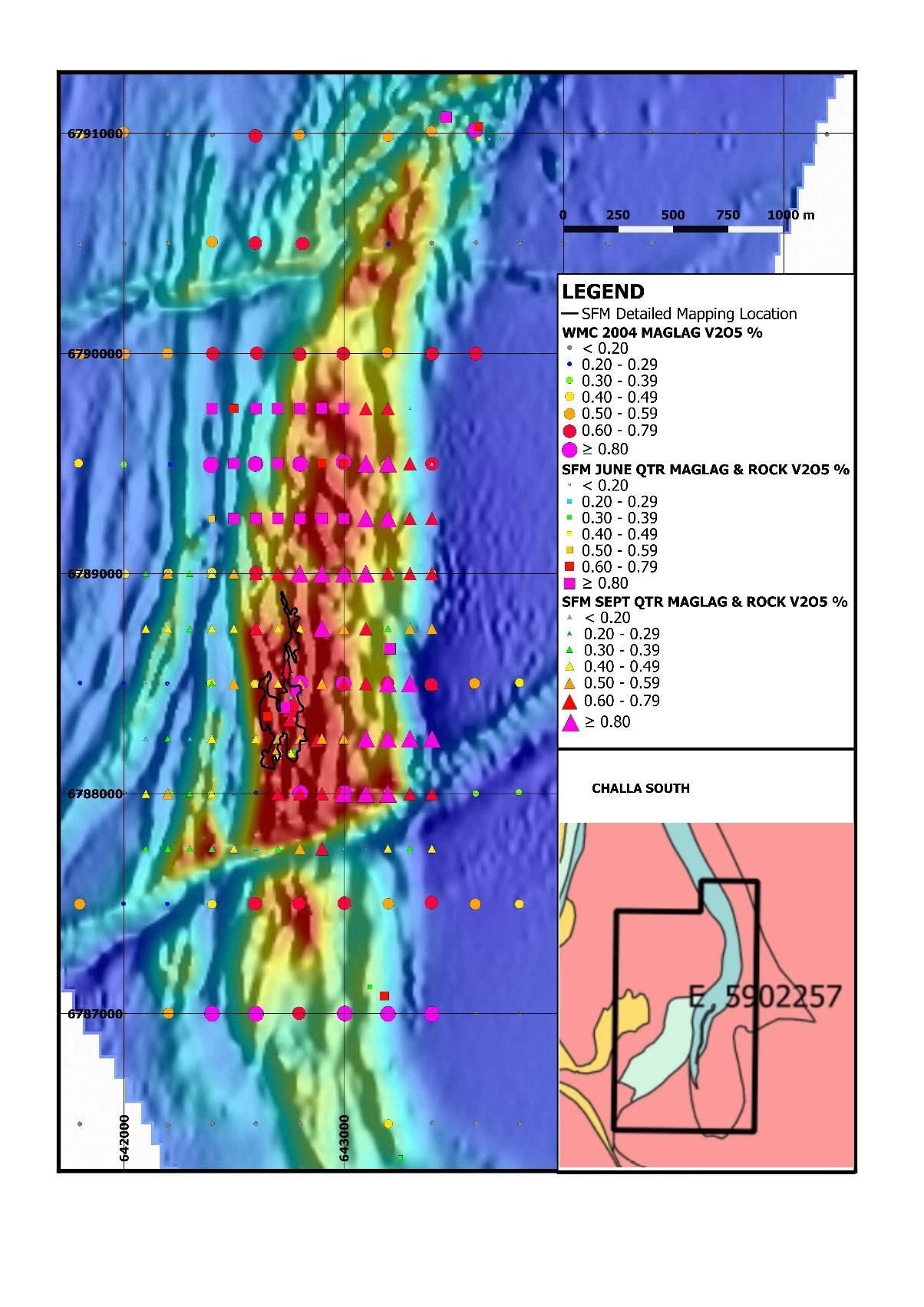
Initial mapping has discovered meta-gabbro outcrop and magnetite banding at Watson’s Well within a broader 5km long magnetic anomoly. Recent rock chip sampling has shown peak values up to 1.64% Vanadium Pentoxide (V2O5). 21 MagLag samples have been taken by Santa Fe and returned grade between 0.56% and 1.23% V2O5 (average grade 0.96% V2O5). In light of this, the Company is now investigating the potential for Windimurra style Vanadium/Magnetite/Titanium mineralisation.

Inset-A.jpg#asset:425:fullWidth
Insert Image - A Santa Fe rock chip and maglag sampling

Inset-B.png#asset:424
Inset Image B - Southern Outcrop

Yarrambie - Nickel/Cobalt/Copper

The Yarrambi Prospect is located within the lower zone of the Narndee complex. The prospect covers a shallow rise of outcropping serpentinised dunite, pyroxenite and gabbronorites interpreted to belong to the Middle Zone of the Narndee LIC, surrounded by colluvium and recent alluvial deposits.

Aeromagnetic interpretation suggest that a number of faults dislocate the intrusive sequence. These faults appear to be deep seated structures and are believed to be long lived, and may have acted as a feeder for mineralised fluids.

The prospect was initially identified as a magnetic bullseye anomaly. Regional maglag sampling undertaken by WMC on a 500m by 200m pattern across the area identified a coincident copper, cobalt and nickel geochemical anomaly, corresponding with the magnetic bulls-eye target.

Screenshot-2017-12-15-12.21.44.png#asset:351:fullWidth
Figure 7 Yarrambie Project Aeromagnetic image and anomalous maglag metal contours and rock chip locations

The Yarrambie Project is a conceptual magmatic nickel and copper sulphide target. The deep seated structures interpreted to cut the olivine rich ultramafic rocks may represent conduit systems for disseminated nickel copper sulphide mineralisation associated with the less evolved magma.

The broad spaced lag anomalism and coincident aeromagnetic high has defined a target that the company considers requires additional testing. The Company intends to test the target by completing a ground electromagnetic geophysical survey followed by reverse circulation or diamond drilling of any conductors identified by the survey. In addition, prospective deep-seated structures are also interpreted to strike through the project area under a veneer of transported cover. The mag lag sampling previously completed over the area is not considered an effective test of this material. The company believes further testing of these structures by auger or shallow RAB geochemical drilling is warranted and may lead to additional targets for further exploration.

Additional Prospectivity

The South Challa Project area secures significant exposure to the Yaloginda Formation, which comprises a sequence of felsic volcanics, volcanic sedimentary rocks metasediments and banded iron formation. There are many copper and copper-zinc prospects within the Yaloginda Formation in the vicinity of the Challa South Project area. These indicate the formation could be prospective for volcanogenic massive sulphide mineralisation. To date, no specific VMS target has been identified within the Challa South Project, however the company believes exploration for this style of mineralisation is warranted. Future work programs including mapping and geochemical sampling are planned.